
Maternal Mitochondrial DNA: What It Is and How It Is Inherited
Assisted reproduction programmes at Feskov Human Reproduction Group (FHRG) may use either a patient's own eggs or donor eggs, depending on medical indications and the programme selected.
- What Is Maternal Mitochondrial DNA and What Does It Do?
- Why Does Mitochondrial DNA Matter for a Child's Health?
- Maternal Mitochondrial DNA in Assisted Reproduction
- Genetic Counselling and Medical Support in FHRG Programmes
- How Is Maternal Mitochondrial DNA Inherited?
- How Mitochondrial DNA Differs From Nuclear DNA
It is therefore important to understand where a child's genetic material comes from.
Nuclear DNA is inherited from both genetic parents, whereas mitochondrial DNA is passed on through the egg. When donor eggs are used, the egg donor provides the mitochondrial DNA (mtDNA), not the woman who carries the pregnancy.
This distinction helps explain genetic inheritance in egg donation and is relevant when assessing the risk of inherited disorders during family planning. Below, we explain what maternal mitochondrial DNA is, how it differs from nuclear DNA and why it matters for a child's health.
What Is Maternal Mitochondrial DNA and What Does It Do?
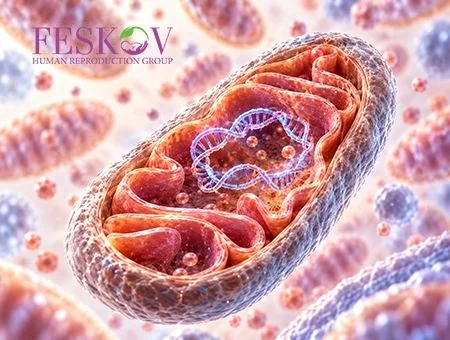
Mitochondria are structures inside cells that help produce energy. They have their own small genome, known as mitochondrial DNA. It is a circular molecule containing around 16,600 base pairs and 37 genes. Thirteen of these genes encode proteins involved in cellular energy production. The remaining genes encode ribosomal and transfer RNA, which are needed to make proteins within the mitochondria.
The term “maternal mitochondrial DNA” does not refer to a separate type of DNA; it describes how mitochondrial DNA is inherited. Mitochondrial function also depends on genes in the cell nucleus, as the mitochondrial genome encodes only some of the proteins required.
How Is Maternal Mitochondrial DNA Inherited?
Mitochondrial DNA passes from the egg to children of both sexes, but only daughters pass it on to the next generation. Sons inherit this genetic material too, but do not transmit it to their children.
Different variants of mitochondrial DNA can coexist within a single cell, a phenomenon known as heteroplasmy. Their proportions may change as eggs develop, meaning that children of the same mother can inherit a mutation at different levels. Not every genetic change, however, causes disease.
Sperm also contain mitochondria, but under normal circumstances paternal mitochondrial DNA is not passed on to the child.
How Mitochondrial DNA Differs From Nuclear DNA
Understanding the key differences between nuclear and mitochondrial DNA helps explain maternal inheritance. The table below compares their main characteristics.
| Characteristic | Mitochondrial DNA | Nuclear DNA |
|---|---|---|
| Main function | Contributes to cellular energy metabolism | Contains most of the body's hereditary genetic information |
| Location | Mitochondria | Cell nucleus |
| Number of copies | Many copies in each cell | Two copies of most chromosomes in each cell |
| Structure | Circular molecule | Linear molecules organised into chromosomes |
| Inheritance | Passed on through the egg | Inherited from both parents |
| Approximate genome size | About 16,600 base pairs | About 3 billion base pairs per set of chromosomes |
| Number of genes | 37 | Around 20,000 |
Mitochondrial DNA can be used to trace a person's maternal lineage. It does not, however, reveal their entire ancestry or determine most of a child's physical traits.
Why Does Mitochondrial DNA Matter for a Child's Health?
Mitochondrial DNA plays an important role in cellular energy production and can be involved in certain disorders. Mitochondria produce ATP, while chloroplasts in plant cells convert light energy into chemical energy. The brain, heart, muscles and eyes are particularly sensitive to problems with energy metabolism.
Mitochondrial DNA is not the only factor affecting a child's health. Nuclear genes, environmental influences and the course of pregnancy also matter. Some mitochondrial mutations can cause inherited disorders, including:
- MERRF — a condition involving myoclonic epilepsy and muscle impairment;
- Leber hereditary optic neuropathy — a disorder that can cause loss of vision;
- MELAS — a syndrome affecting the muscles and nervous system and causing stroke-like episodes.
Having a pathogenic variant does not necessarily mean that symptoms will develop. Their severity depends on the mutation and its proportion in different tissues. Moreover, not all mitochondrial disorders are linked to maternally inherited mtDNA: some result from changes in nuclear genes that can also be inherited from the father.
Maternal Mitochondrial DNA in Assisted Reproduction
When natural conception is not possible, in vitro fertilisation (IVF) may be an option. The egg remains the source of mitochondrial DNA in IVF because it is through the egg that the child receives this genetic material. If the intended mother's own egg is used, the child's mitochondrial genome comes from her. If a donor egg is used, the child inherits the donor's mitochondrial DNA.
Egg donation should not be confused with mitochondrial donation techniques. These may involve transferring nuclear genetic material into an egg or embryo containing donor mitochondria.
In gestational surrogacy, the woman carrying the pregnancy generally receives an embryo created without using her own eggs. In this situation, the child's mitochondrial DNA comes from the intended genetic mother or the egg donor. Pregnancy itself does not alter the embryo's mitochondrial genome. The surrogate's health and the conditions during pregnancy nevertheless play an important role in the child's development.
Genetic Counselling and Medical Support in FHRG Programmes
If mitochondrial disorders have occurred in any generation of a family, consultation with a clinical geneticist is advisable before embryos are created. FHRG provides genetic counselling as part of assisted reproduction programmes to assess risks and determine which investigations are appropriate.
PGT-A is used to analyse embryos for aneuploidies, or abnormal chromosome numbers. It assesses chromosome number but does not rule out pathogenic variants in maternal mitochondrial DNA. PGT-A is not included in every programme. If such variants are suspected or identified through specialised testing, specialist assessment is needed. The FHRG team helps determine the most appropriate investigations based on family history and the circumstances of each case.
- Surrogate motherhood - how not to be deceived
- Advantages of guaranteed surrogacy programs over programs with guaranteed compensation
- Surrogacy in Mexico: What You Need to Know
- Guarantee Remote Surrogacy Programs at FHRG
- Portugal allows Surrogacy for medical reasons
- Surrogacy: who is legally recognised as the mother in Portugal?
- Surrogacy in Brazil: costs, legal status and how the process works
- Tests during pregnancy: medical care in a surrogacy programme
- Portugal's new citizenship law in 2026: what is changing?
- Countries Where Surrogacy Is Legal

 subscribe
Join my mailing list to receive the latest news and updates

Is Mitochondrial DNA Inherited Exclusively From the Mother?
read moreUnder the usual pattern of inheritance, mitochondrial DNA is transmitted through the egg.Do Sons and Daughters Inherit the Same Mitochondrial DNA?
read moreChildren of both sexes receive mitochondrial DNA from the egg, but the proportions of different variants can differ.Can Mitochondrial DNA Mutate?
read moreYes. Mutations can be inherited or arise spontaneously.Whose Mitochondrial DNA Does a Child Inherit When a Donor Egg Is Used?
read moreWith conventional IVF, the child inherits mitochondrial DNA from the egg donor.Does a Surrogate Pass Her Mitochondrial DNA to the Child?
read moreNo, provided her own eggs were not used to create the embryo.

The reproduction of any information presented on the site in whole or in part, in any text, graphics or video format is prohibited without the permission of the site administration. By copying the data, you agree to this requirement and assume full responsibility in the event of its violation.
© 1995 - 2026 SURROGATE MOTHERHOOD CLINIC OF PROFESSOR FESKOV in coopertion with Alpha Group Ltd